 Grodno State


КА2 – Cooperation for innovation and the exchange of good practices
CAPACITY BUILDING IN HIGHER EDUCATION
ERASMUS+ КА2
«SETTING PEER REVIEW INSTRUMENTS AND GOALS FOR MEDICAL (HEALTH) EDUCATION» / SPRING
Project reference number 609528-EPP-1-2019-1-GE-EPPKA2-CBHE-JP
Realization: 2020-2023
List of partner institutions
Applicant institution:
BAU International University Batumi LTD (Batumi, Georgia)
Project coordinator – Professor Levan Metreveli, MD, PhD, MPH, Professor of Public Health, Department of Basic Sciences, Faculty of Medicine BAU International University Batumi)
Web-site of the Project: http://www.bau-spring.ge/
Co-beneficiary institutions:
- Tbilisi State Medical University (Tbilisi, Georgia)
- Petre Shotadze Tbilisi Medical Academy LLC (Tbilisi, Georgia)
- Georgian National University SEU (Tbilisi, Georgia)
- Nicolae Testeitanu State University of Medicine and Pharmacy of the Republic of Moldova (Chisinau, Moldova)
- Technical University of Moldova (Chisinau, Moldova)
- International Sakharov Environmental Institute of Belarusian State University (Minsk, Belarus)
- Grodno State Medical University (Grodno, Belarus) Project coordinator in the co-beneficiary institution – Surmach Marina Yurievna, Doctor of Medical Sciences, Associate Professor, Head of the Department of Public Health and Healthcare.
- Asfendiyarov Kazakh National Medical University noncommercial joint stock company (Almaty, Kazakhstan)
- Karaganda State Medical University (Karaganda, Kazakhstan)
- The State Higher Educational Institution Avicenna Tajik State Medical University (Dushanbe, Tajikistan)
- The State Higher Educational Institution Khatlon State Medical University (Danghara, Tajikistan)
- Medical University Sofia (Sofia, Bulgaria)
- Lithuanian University of Health Sciences (Kaunas, Lithuania)
The aim of the project is to enhance the quality of medical education in the involved partner countries and contribute to the onset of changes of the same character in the rest of former Soviet countries.
Through various activities on capacity building, peer reviewing, exchanging experience, creating the foundation for sustainable development and further dissemination of final results of the project, the consortium of 14 higher educational institutions from 7 countries intends to achieve the following results:
- raising awareness on peer review process as an effective instrument for substantiating ongoing improvements in academic and administrative domains of medical schools in targeted partner countries and beyond;
- establishing a multinational peer review board (MPRB);
- establishing and building consistency for a continuous peer-review process of academic programs and processes and administrative policies, procedures and actions across the targeted partner countries and beyond;
- capacity building of faculty members and administrative staff;
- establishing an annual scientific-practical journal of “Peer Review in Medical/Health Education for Eastern Europe and Central Asia (PRIMED-EECA)”;
- enhancing internationalization of HEIs in partner countries;
- disseminating information on project achievements and other final products to participant institutions in program and partner countries.
The project will ensure the sustainability of the achieved results and their application in the very near future through the establishment of the above mentioned journal and independent cross-national “Peer Review Association for Medical/Health Education of Eastern Europe and Central Asia – PRAMED-EECA)” aimed at:
а. providing the group of highly qualified reviewers;
б. assisting medical education institutions of the targeted regions in the effective preparation for international accreditation.
А regular online national monitoring of the international technical assistance took place
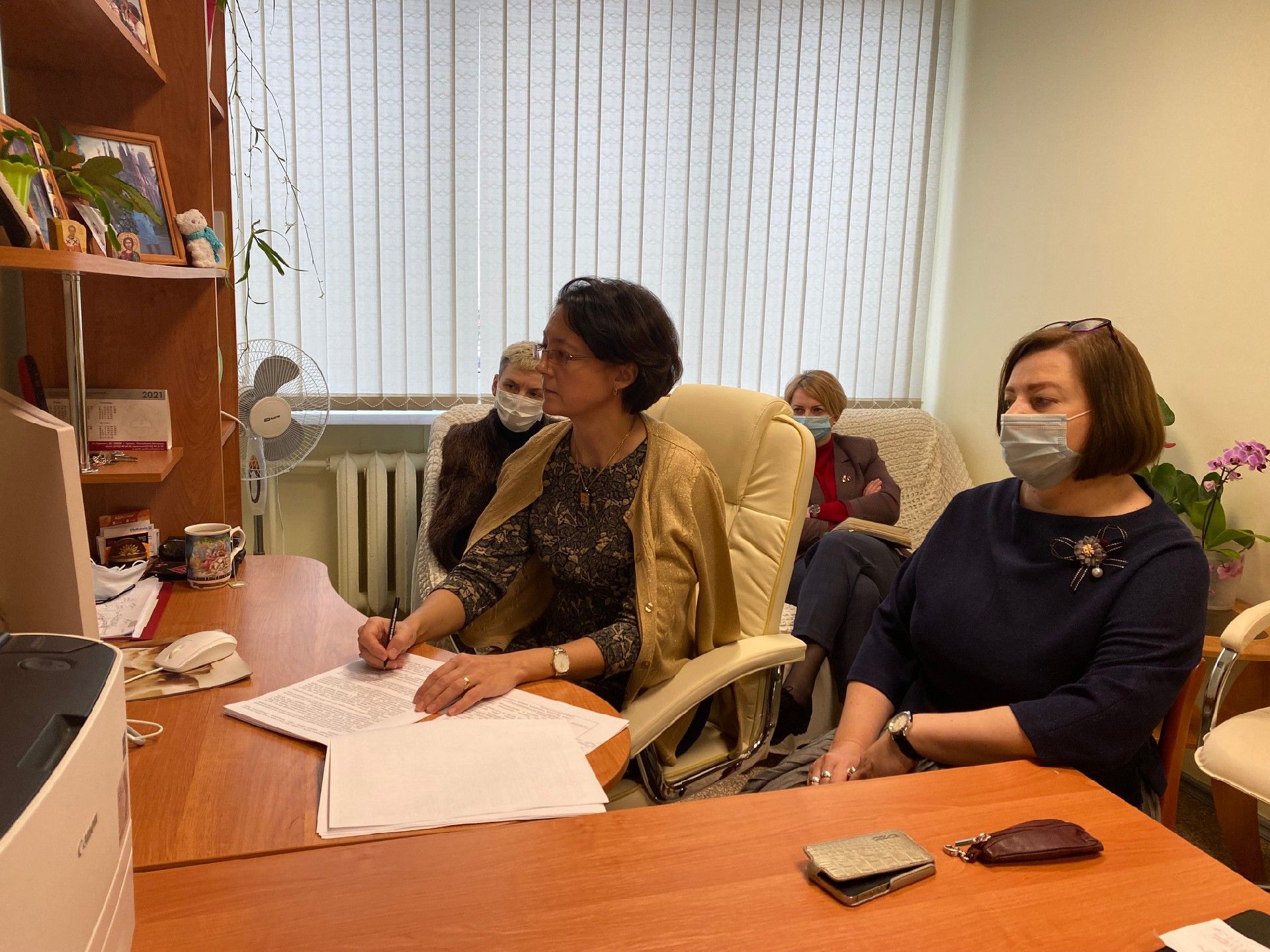
On November 10, 2021 a regular online national monitoring of the international technical assistance ERASMUS+КА2+ project “SPRING = Setting peer review instruments and goals for medical (health) education” took place.
The monitoring was carried out by the National Office of Erasmus + in Belarus (NEO) and attended by: Minich Oksana Anatolyevna, Head of NEO in the Republic of Belarus; Minyukovich Ekaterina Aleksandrovna and Irina Grigorievna Labkova, ERASMUS + office administrators.
The event involved the project coordinator from BAU International University, Batumi, Georgia, Professor Levan Metreveli, as well as the representatives of International Sakharov Environmental Institute of the Belarusian State University (ISEI BSU) and Grodno State Medical University (GrSMU).
The project coordinators Associate Professor Alexey Grigorievich Sysa, Dean of the Faculty of Ecological Medicine, ISEI BSU and Professor Marina Yurievna Surmach, Head of the Department of Public Health and Health Service of GrSMU prepared a report on the progress and results of the project, drawn up in accordance with the requirements for preliminary and advisory monitoring (in Russian), as well as the presentation (in English).

The agenda of the online monitoring included:
- Opening speech by Professor Sergei Aleksandrovich Maskevich, Director of ISEI BSU.
- Welcoming speech by Professor Levan Metreveli, the project coordinator from BAU International University, Batumi, Georgia.
- Introduction of the monitoring aims and objectives to the stakeholders by the representatives of NEO in Belarus: Minich Oksana Anatolyevna, Head of the National Office of ERASMUS + in the Republic of Belarus; Minyukovich Ekaterina Aleksandrovna and Irina Grigorievna Labkova, ERASMUS + office administrators.
- Presentation of the SPRING project results by the project coordinators from both Belarusian partner universities.
Further discussion of the project implementation was attended by Minich Oksana Anatolyevna, Head of NEO in the Republic of Belarus; Minyukovich Ekaterina Aleksandrovna and Irina Grigorievna Labkova, ERASMUS + office administrators, Professor Levan Metreveli, the project coordinator from BAU International University, Batumi, Georgia; representatives of ISEI BSU: Associate Professor Alexey Grigorievich Sysa, Dean of the Faculty of Ecological Medicine, the project coordinator, Alekseychik Elena Valerievna, Head of the Department of International Relations, project manager; Buchenkov Igor Eduardovich, Deputy Director for Academic and Educational Work, expert teacher; Chemeneva Natalya Nikolaevna, deputy chief accountant, project accountant; Loban Ekaterina Vladimirovna, specialist of the II qualification category of the International Relations Department, translator of the project; representatives of GrSMU: Professor Marina Yurievna Surmach, Head of the Department of Public Health and Health Service, project coordinator, Yanina Vladislavovna Razvodovskaya, Head of the Department of Foreign Languages, expert teacher; Mozalevich Oksana Iosifovna, Head of the International Relations Department, project manager; Mankevich Lyudmila Leonidovna, chief accountant, project manager.
Upon completion of the discussion, the project participants were familiarized with the preliminary results of the monitoring: Minich Oksana Anatolyevna, Head of NEO in the Republic of Belarus; Minyukovich Ekaterina Aleksandrovna and Irina Grigorievna Labkova, ERASMUS + office administrators noted the significance of the results achieved. The partner universities were recommended to intensify the work on the equipment purchasing and submitting the information about SPRING project implementation to the university websites and the project website, as well as to expand the dissemination of the project results among the stakeholders.
