 Grodno State


КА2 – Cooperation for innovation and the exchange of good practices
CAPACITY BUILDING IN HIGHER EDUCATION
ERASMUS+ КА2
«SETTING PEER REVIEW INSTRUMENTS AND GOALS FOR MEDICAL (HEALTH) EDUCATION» / SPRING
Project reference number 609528-EPP-1-2019-1-GE-EPPKA2-CBHE-JP
Realization: 2020-2023
List of partner institutions
Applicant institution:
BAU International University Batumi LTD (Batumi, Georgia)
Project coordinator – Professor Levan Metreveli, MD, PhD, MPH, Professor of Public Health, Department of Basic Sciences, Faculty of Medicine BAU International University Batumi)
Web-site of the Project: http://www.bau-spring.ge/
Co-beneficiary institutions:
- Tbilisi State Medical University (Tbilisi, Georgia)
- Petre Shotadze Tbilisi Medical Academy LLC (Tbilisi, Georgia)
- Georgian National University SEU (Tbilisi, Georgia)
- Nicolae Testeitanu State University of Medicine and Pharmacy of the Republic of Moldova (Chisinau, Moldova)
- Technical University of Moldova (Chisinau, Moldova)
- International Sakharov Environmental Institute of Belarusian State University (Minsk, Belarus)
- Grodno State Medical University (Grodno, Belarus) Project coordinator in the co-beneficiary institution – Surmach Marina Yurievna, Doctor of Medical Sciences, Associate Professor, Head of the Department of Public Health and Healthcare.
- Asfendiyarov Kazakh National Medical University noncommercial joint stock company (Almaty, Kazakhstan)
- Karaganda State Medical University (Karaganda, Kazakhstan)
- The State Higher Educational Institution Avicenna Tajik State Medical University (Dushanbe, Tajikistan)
- The State Higher Educational Institution Khatlon State Medical University (Danghara, Tajikistan)
- Medical University Sofia (Sofia, Bulgaria)
- Lithuanian University of Health Sciences (Kaunas, Lithuania)
The aim of the project is to enhance the quality of medical education in the involved partner countries and contribute to the onset of changes of the same character in the rest of former Soviet countries.
Through various activities on capacity building, peer reviewing, exchanging experience, creating the foundation for sustainable development and further dissemination of final results of the project, the consortium of 14 higher educational institutions from 7 countries intends to achieve the following results:
- raising awareness on peer review process as an effective instrument for substantiating ongoing improvements in academic and administrative domains of medical schools in targeted partner countries and beyond;
- establishing a multinational peer review board (MPRB);
- establishing and building consistency for a continuous peer-review process of academic programs and processes and administrative policies, procedures and actions across the targeted partner countries and beyond;
- capacity building of faculty members and administrative staff;
- establishing an annual scientific-practical journal of “Peer Review in Medical/Health Education for Eastern Europe and Central Asia (PRIMED-EECA)”;
- enhancing internationalization of HEIs in partner countries;
- disseminating information on project achievements and other final products to participant institutions in program and partner countries.
The project will ensure the sustainability of the achieved results and their application in the very near future through the establishment of the above mentioned journal and independent cross-national “Peer Review Association for Medical/Health Education of Eastern Europe and Central Asia – PRAMED-EECA)” aimed at:
а. providing the group of highly qualified reviewers;
б. assisting medical education institutions of the targeted regions in the effective preparation for international accreditation.
TRAINING ONLINE VISIT for international accreditation programs as part of SPRING project
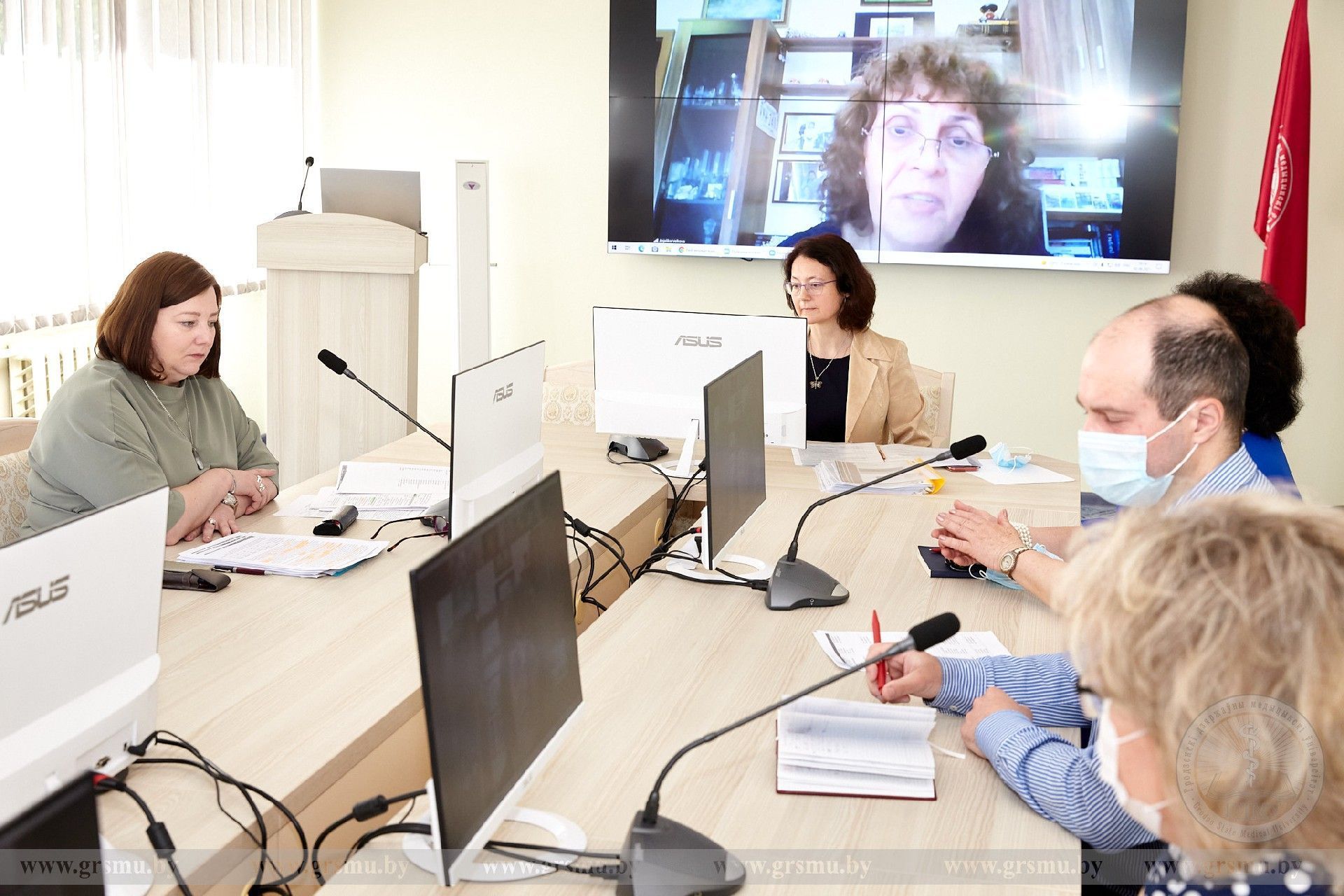

On June 02-03, 2021 GrSMU underwent a training online visit by the experts of the Multinational Peer Review Board (MPRB) as part of Erasmus KA2 logistical support project “Setting peer review instruments and goals for medical (health) education (SPRING)” registered by the Ministry of Economy of the Republic of Belarus on July 27, 2020 No. 2/20/001096. The purpose of the visit was to train the University staff for the participation in international accreditation procedures.


The training visit program was built according to the requirements of the World Federation for Medical Education (WFME) for international accreditation of medical universities.
Prior to the date of visit, the working group of the project from the GrSMU developed a training self-evaluation report (SER) on the University's activities. The requirements for this report were previously developed by the project board and presented to all participating universities of SPRING project. These requirements included 12 standards with check-points for each one, English being the working language.
The training SER on GrSMU activities was submitted by the University working group for consideration within the deadline set in SPRING project.

Within two days (02.06.2021 – 03.06.2021) MPRB experts interviewed target groups of GrSMU: the University Top Management, Deans, members of the University Council, the project working group and SER developers, students, representatives of University alumni, the teaching staff of the Departments and curriculum developers, as well as an online meeting with employers.
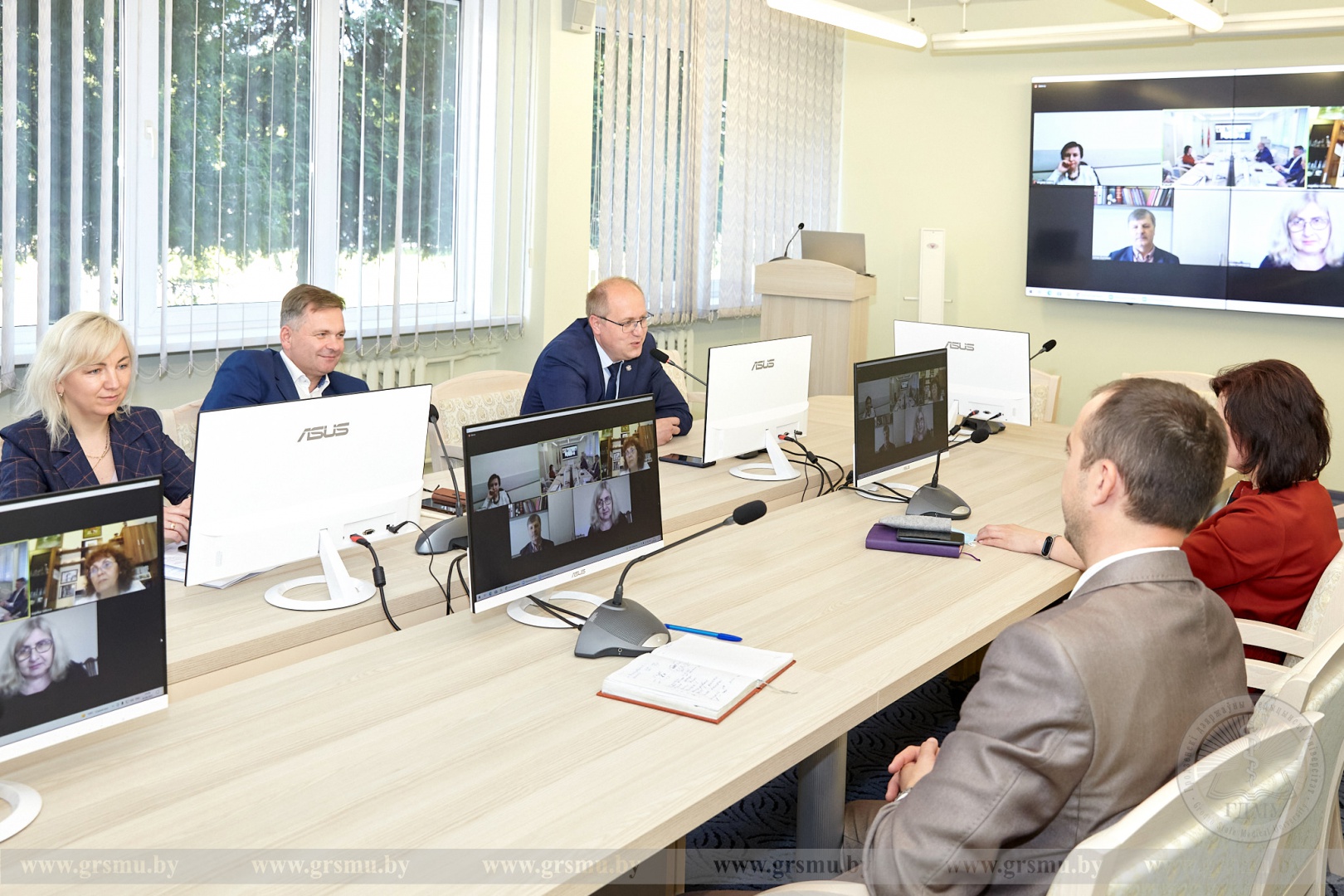


The experts were represented by professors and associate professors from among the staff of the universities participating in the consortium of universities in the project, namely:
- Professor Angelika Velkova (Medical University Sofia, Bulgaria),
- Professor Linas Šumskas (Lithuanian University of Health Sciences, Kaunas, Lithuania),
- Associate Professor Nino Kandelaki (Tbilisi State Medical University, Tbilisi, Georgia),
- Associate Professor Virginia Salaru (Nicolae Testeitanu State University of Medicine and Pharmacy of the Republic of Moldova).
When summing up the results, the experts shared their impressions.

MPRB experts gave the University a very high rating in terms of the WFME criteria.
Thus, Professor Angelika Velkova acknowledged:
- Dedicated staff: highly skilled, creative, and intelligent employees.
- High educational culture of the staff.
- Involvement of employers in the educational process.
- Fully developed and high organizational culture of the University: starting from a clear organizational structure, understandable and clear processes, good organization of work to a vision of the future, both immediate and strategic.
- High activity of the University to improve its performance: starting from the anticipated risks and their prevention to the assessment of the implementation of plans and their timely correction.
- An impressive volume of international students, as well as the activity to increase the export potential of the University.
- Impressive achievements of the University in various fields.
- Faith and motivation of the staff in striving to achieve the leadership position of the University.
Professor Linas Šumskas underlined:
- High quality of SER.
- Disciplined and organized employees.
- An impressive strategic development plan; University objectives are achievable and are compatible with the set goals.
- High competence of the University Top Management.
- The infrastructure and equipment of the clinical sites are sufficient and of high level.
- Internationalization of research activities: participation in international research projects, conferences, publications in international journals.
- An effective system for recruiting international students.
- High level of healthcare system development in the region as a whole.
Associate Professor Nino Kandelaki made notice of:
- Use of traditional and innovative teaching methods, implementation of OSCE.
- Practice-oriented training.
- Student-centered orientation of the educational process.
- Teaching the principles of scientific thinking and deep study of fundamental disciplines by students.
- Possibility of training teachers foreign languages at the premises of the University, and good opportunities for pedagogical training of teachers as well.
- Provision of educational programs for studying foreign languages by medical students.
Associate Professor Virginia Salaru mentioned:
- The University has a simulation laboratory.
- Opportunities for practical training at the University clinic.
- Participation of employers in ensuring the quality of education.
- Collaboration with healthcare organizations.
According to the unanimous opinion of the MPRB experts, the University, students and employers give the impression of one united "team" working together to achieve a common goal, expressed in the Mission of the University.

Despite the overall appreciation and positive impression of the University, according to the existing requirements (WFME), the experts also needed to provide recommendations for improvement. The preliminary recommendations of the experts, voiced at the final meeting, were as follows:
We recommend better harmonizing the national system of credits (credit units) with the European (Bologna) system, which, as a result, will increase students’ mobility, reduce the classroom work load of students and teachers.
The final conclusion by the expert commission will be presented in writing, as required by the principles of the international accreditation procedure.
 During the interviews, the experts not only assessed the University in terms of compliance with the WFME criteria, but also shared their own experience of such activities in their universities and countries, positive developments, and expressed confidence that in the future, after the completion of the project, cooperation in the academic, scientific and professional spheres between our partner universities will continue.
Project coordinator in GrSMU,
Dr.Sc. (Medicine), Prof. M.Yu.Surmach